Music
Can one Bowie song tell you the whole album?
Start with David Bowie's five most-streamed studio tracks, then open the albums behind them. Length, tempo, energy, valence and acousticness show when the hit is a useful guide — and when it really isn't.

This Bowie project started with a fairly simple list.
His five most-streamed canonical studio tracks in my 25 September 2026 snapshot:
Starman. “Heroes”. Space Oddity. Rebel Rebel. Life on Mars?
Five songs. Five albums.
But how much does the song everyone knows actually tell you about the album around it?
That question grew out of two earlier Bowie pieces: Bowie never needed the three-minute rule and Every Bowie album has a shape.
This time I kept the track lengths, then added Tempo, Energy, Valence and Acousticness.
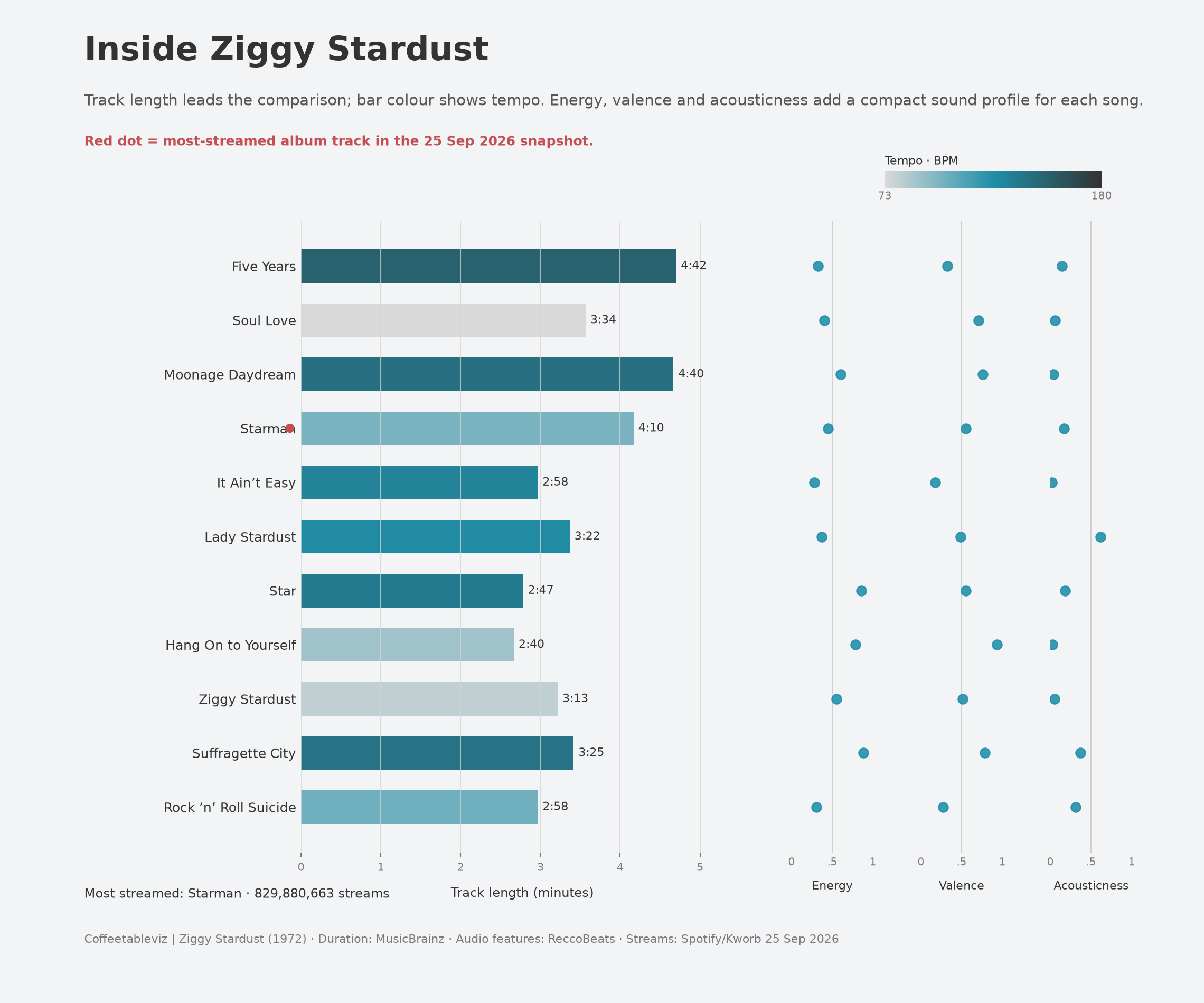
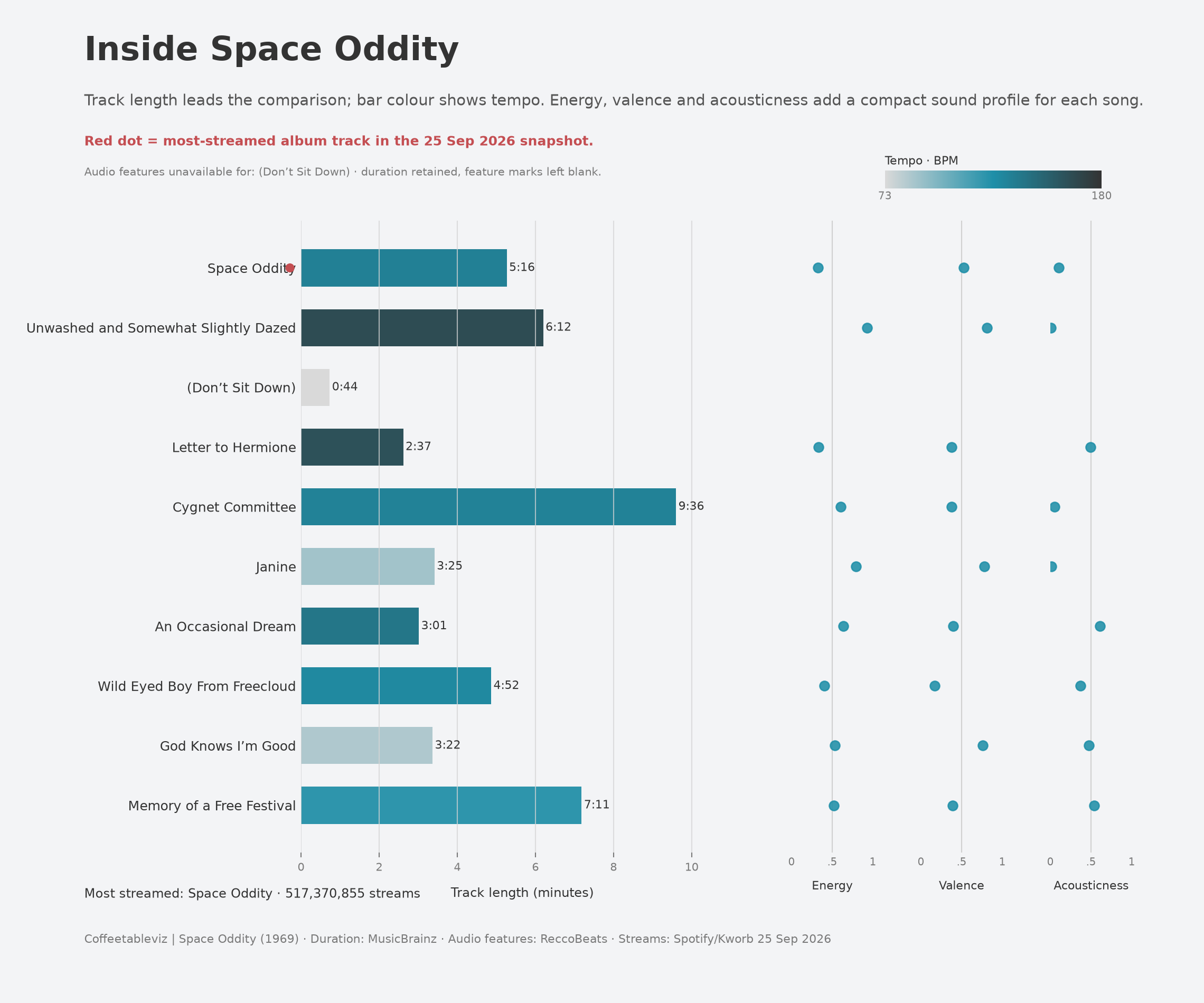
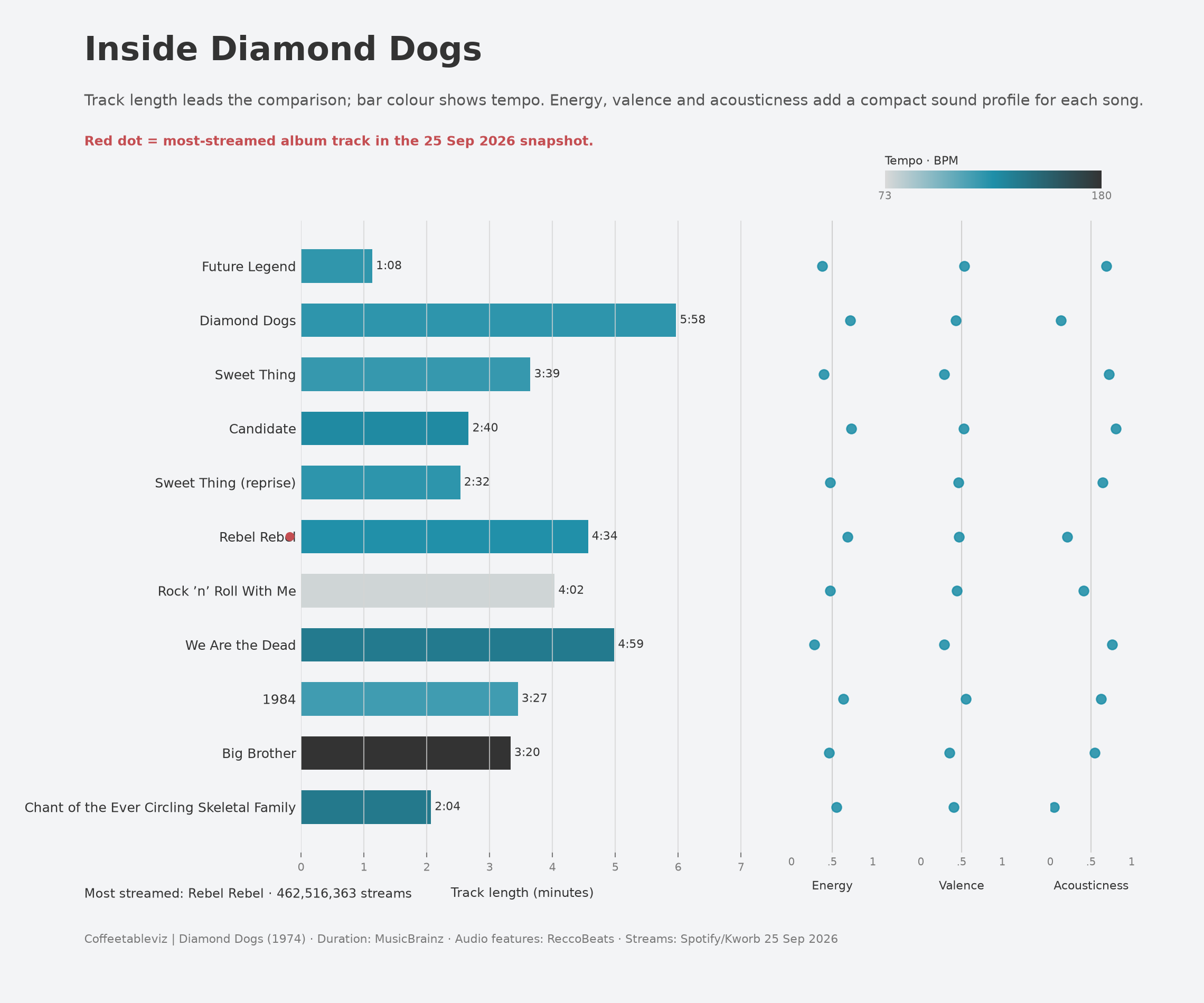
The red dot is the album’s most-streamed track.
The rest of the album gets to answer back.
Five hits, five albums
Each chart works the same way.
Bar length is the canonical album-track duration. Bar shade is Tempo, using one common scale across all five albums. The three dot columns show ReccoBeats Energy, Valence and Acousticness on 0–1 scales.
The important bit is consistency.
A dark tempo bar means the same thing from Space Oddity to Heroes. A dot at 0.8 Energy means the same thing in every panel.
So where does the red dot sit?
Ziggy Stardust: Starman is surprisingly typical
I expected the biggest song to sit somewhere obvious.
It does — just not in the way I expected.
Starman is 4:10, compared with a Ziggy median of 3:22, and its Tempo is slower than the album median.
But its Energy is 0.449 — exactly the album median.
Its Valence is 0.549 — also exactly the album median.
Acousticness is close too: 0.166 against 0.142.
So the hit is structurally different, but on those sound-profile measures it sits remarkably close to the centre.
Heroes: the long song that still sounds like the album
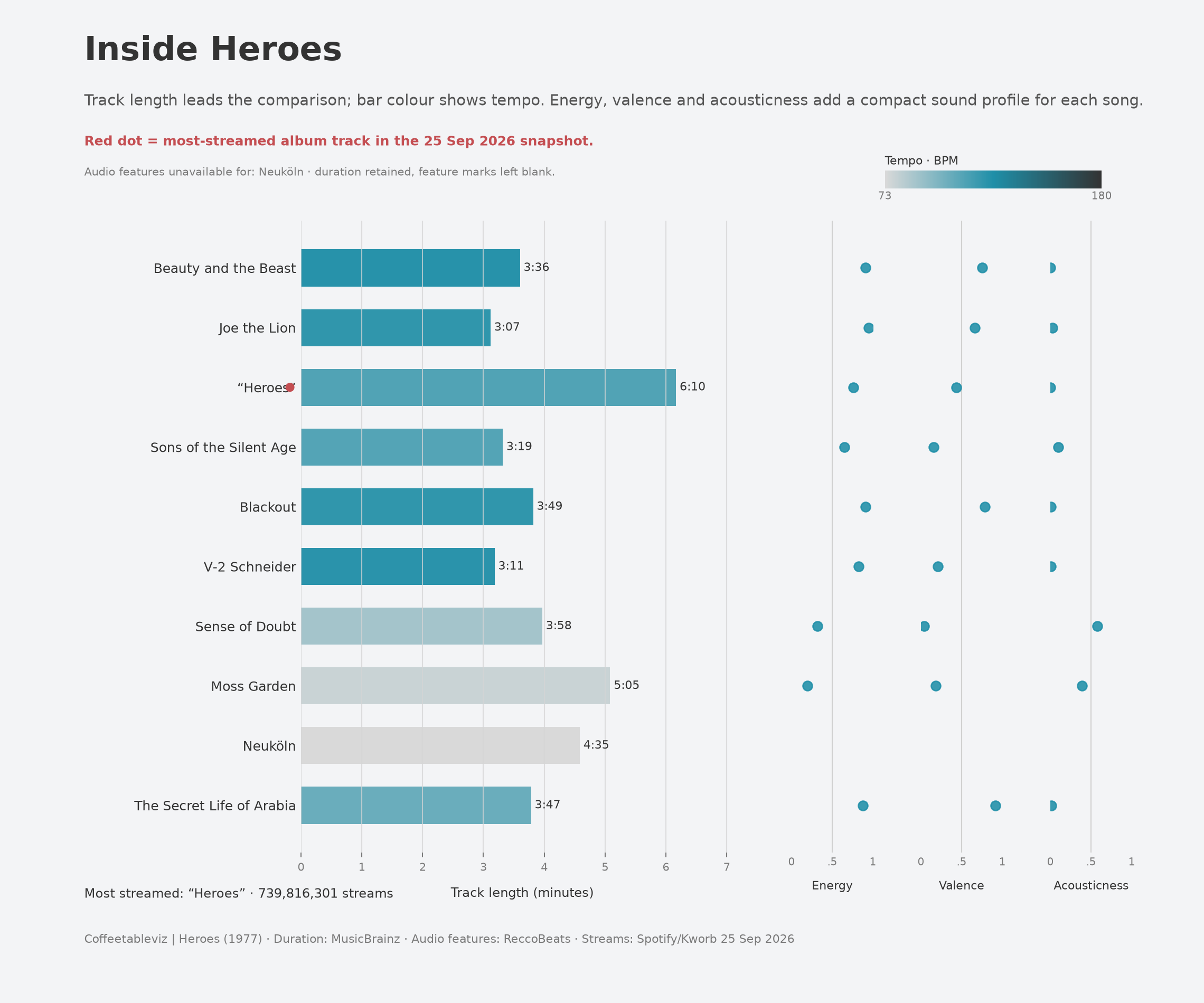
“Heroes” is 6:10.
The album median is 3:48.
That looks like an obvious outlier — and in length, it is.
Yet its Tempo is 112.1 BPM, exactly the matched-album median.
Its Valence is 0.435, also exactly the median.
Energy is a little lower than the album centre, but still high.
So the song can be structurally unusual while still living comfortably inside the album’s wider sonic family.
Space Oddity: right pace, different profile
The Space Oddity album is sprawling.
There is a 0:44 track and a 9:36 track in the same sequence.
The title track comes in at 5:16, longer than the album median of about 4:09.
Its Tempo, though, is almost exactly typical: 135.2 BPM against 134.3.
Energy is different: 0.323 against a median of 0.534.
Acousticness is too: 0.106 against 0.372.
Same sort of pace. Different part of the sound profile.
Diamond Dogs: Rebel Rebel really isn’t the album
This is the clearest example of the hit giving you the wrong impression.
The Diamond Dogs median track is 3:27.
Rebel Rebel runs 4:34.
Its Energy is 0.686, compared with an album median of 0.476.
And its Acousticness is 0.209, compared with a striking album median of 0.624.
Tempo and Valence are close to typical.
The rest is not.
If Rebel Rebel is your doorway into Diamond Dogs, quite a lot changes once you walk through it.
Hunky Dory: typical pace, different mood
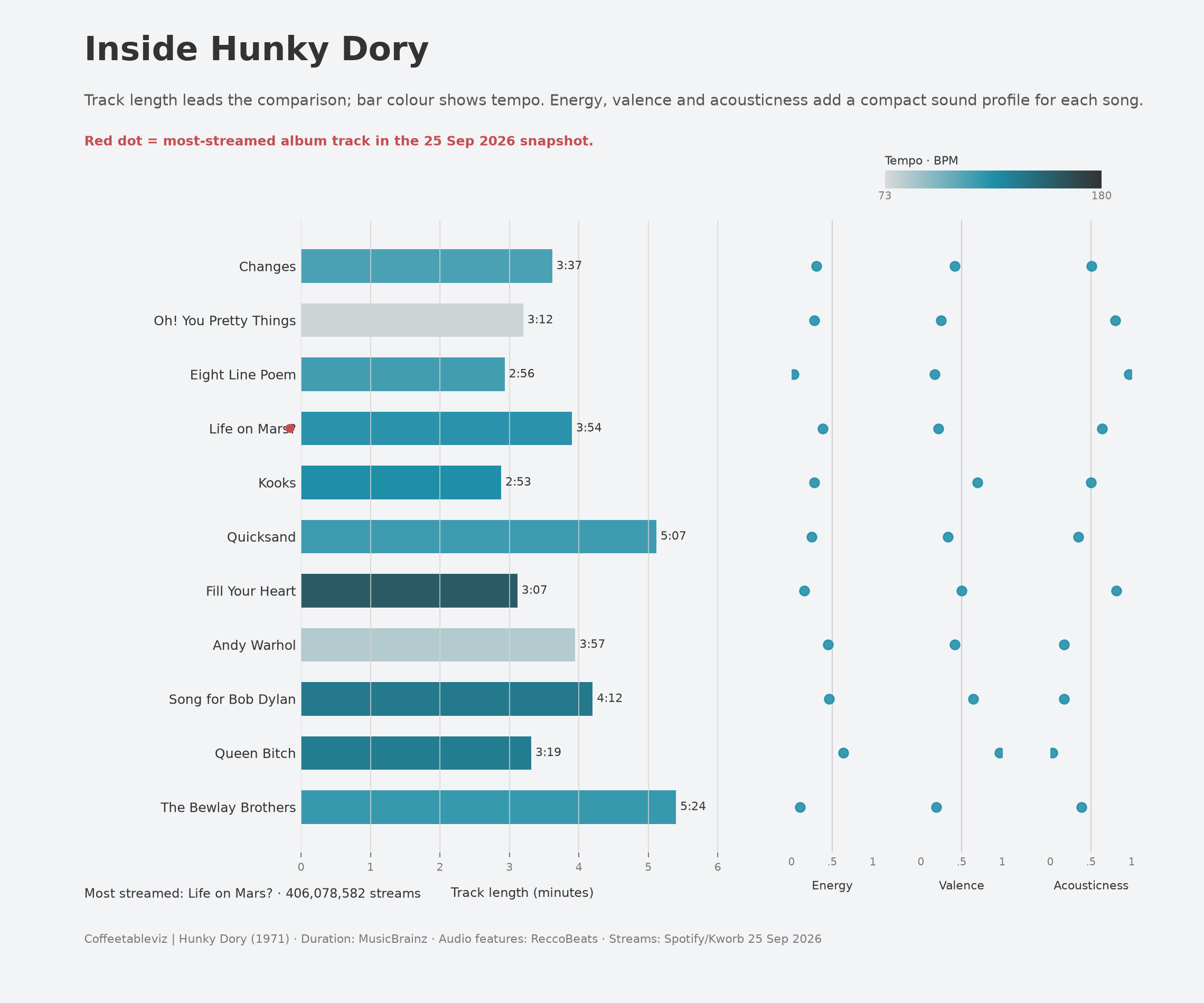
Life on Mars? is 3:54.
The album median is 3:37.
Tempo is close too: 123.3 BPM against 119.8.
But Valence falls to 0.216, compared with the album median of 0.412.
Acousticness moves the other way: 0.635 against 0.501.
A familiar pace does not necessarily mean a typical mood profile.
The albums are doing different things too
The red dots are useful, but the five charts also reveal how different these albums are from one another.
Among the matched tracks:
- Heroes has the highest median Energy: 0.826
- it also has the lowest median Acousticness: 0.00994
- Hunky Dory has the lowest median Energy: 0.278
- Diamond Dogs has the highest median Acousticness: 0.624
- Space Oddity has the highest median Tempo: 134.3 BPM
- Ziggy has the shortest median track length: 3:22
Those are not value judgements about the albums.
They are just different shapes in the data.
And that is really the point.
TLDR
Can one Bowie song tell you the whole album?
Sometimes surprisingly well.
Starman is almost perfectly central to Ziggy on Energy and Valence.
“Heroes” is wildly unusual in length but typical in Tempo and Valence.
Rebel Rebel is the opposite: the biggest song is a pretty poor guide to the Energy and Acousticness profile of Diamond Dogs.
The hit is useful.
It is just an entry point.
simple charts clear stories.