Music
Bowie never needed the three-minute rule
Across 275 David Bowie studio-album tracks, song length changes with the catalogue's musical eras — but shorter tracks do not show a clear streaming advantage.

Three minutes is one of those numbers that hangs around pop music.
Long enough to do something interesting. Short enough not to annoy anyone too much.
David Bowie seems to have treated it more as a suggestion.
I rebuilt his lifetime solo studio catalogue at track level: 275 canonical album tracks across 26 albums, from the 1967 debut to Blackstar in 2016.
Then I added three things: album-level AllMusic Styles, a current Spotify-stream snapshot, and UK singles-chart history.
The useful story is not that Bowie made long songs.
It is that the shape of the songs keeps changing — and shorter tracks do not seem to have a simple advantage.
Bowie stretched the song
Start with the albums.
The 1967 debut has a median track length of just 2:49.
By Station to Station in 1976, the median is 6:02.
Then it drops again.
Then rises again.
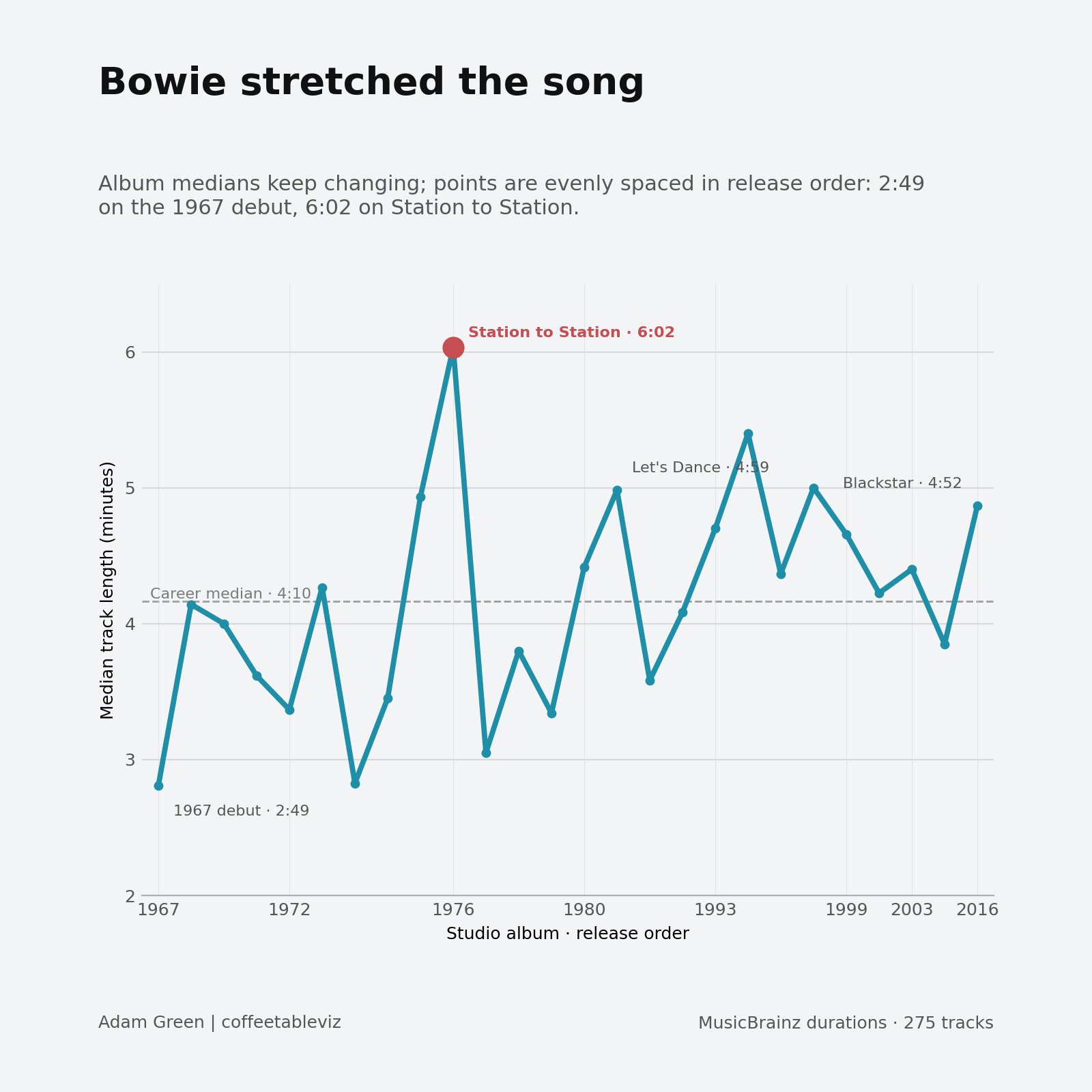
Across the whole catalogue, the median track is 4:10.
But the album medians move around that number constantly.
Pin Ups sits at 2:50.
Low at 3:03.
Let’s Dance at 4:59.
Earthling at 5:00.
The Buddha of Suburbia at 5:24.
So this is not a tidy “songs got longer over time” story.
Bowie keeps changing the shape of the record.
Style changed the clock
That becomes more interesting when the AllMusic Styles are added.
These are album-level labels, and they overlap heavily, so I am not treating them as mutually exclusive song genres.
The better question is narrower:
when an album carries a particular style label, what do its tracks tend to look like in length?
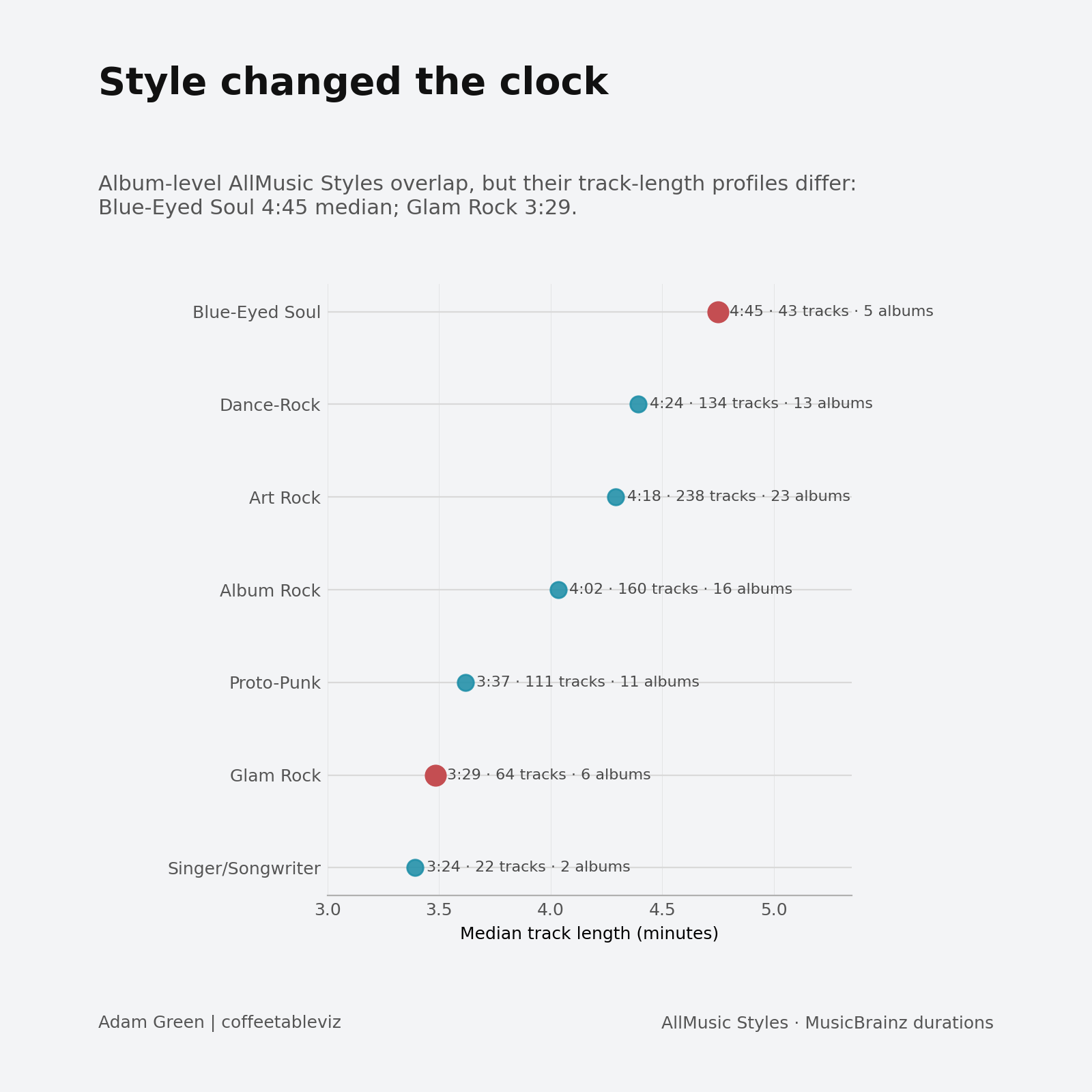
The contrast is substantial.
Tracks on Blue-Eyed Soul-tagged albums have a median length of 4:45.
Dance-Rock: 4:24.
Art Rock: 4:18.
Glam Rock: 3:29.
Singer/Songwriter: 3:24.
That does not mean style caused the song length.
But it does show that Bowie’s changing musical vocabulary coincides with changing track structures.
The reinvention is not just in the labels.
It is also in the clock.
The hits weren’t short
Then comes the obvious assumption.
If shorter songs are easier to consume, perhaps they should be more popular.
The current catalogue does not give that idea much help.
Across 237 matched studio compositions, the relationship between album-track duration and log current Spotify streams is only r = 0.11.
That is very little linear relationship.
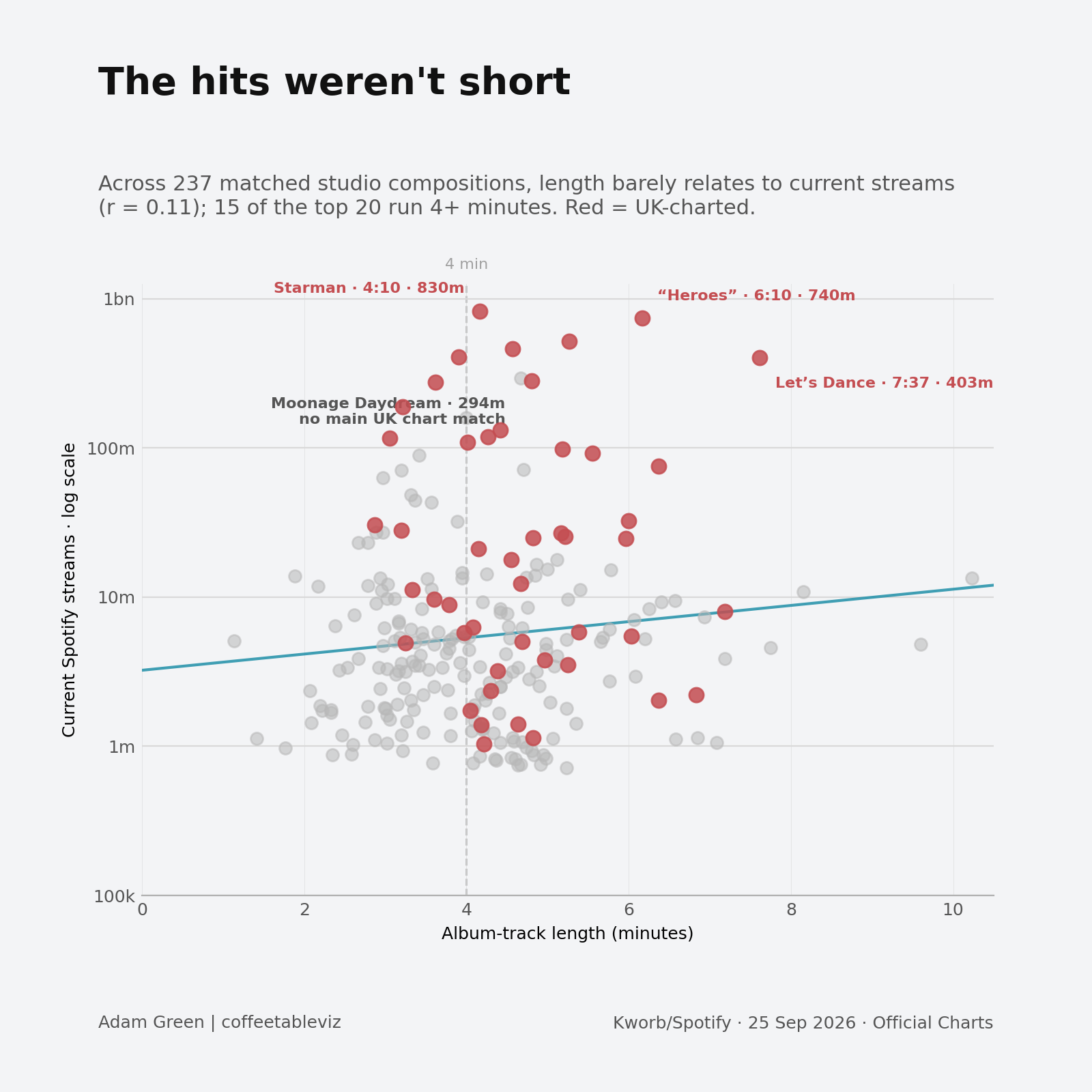
And the most-streamed end is hardly dominated by short songs.
Starman: 4:10.
“Heroes”: 6:10.
Space Oddity: 5:16.
Rebel Rebel: 4:34.
Let’s Dance: 7:37.
In fact, 15 of the current top 20 matched studio compositions are at least four minutes long.
There is a comparability wrinkle worth being explicit about: these are canonical album-track lengths. A historical single may have used a shorter edit. The UK chart data tells us whether the composition appeared on the main singles chart; it does not pretend that the plotted album version was always the exact version bought at the time.
That wrinkle actually makes the story better.
Bowie could make a seven-minute album track, cut it for radio, and still leave the long version as part of the catalogue people stream today.
TLDR
Across 275 canonical studio-album tracks, David Bowie’s songs keep changing shape.
The catalogue median is 4:10, but individual albums swing from well under three minutes to around six.
Those length differences also line up with different AllMusic album Styles.
But shorter tracks do not show a clear current-streaming advantage: across 237 matched compositions, duration vs log streams is only r = 0.11, and 15 of the top 20 run four minutes or longer.
Three minutes was useful.
Bowie just did not seem to regard it as compulsory.
simple charts clear stories.