Film
Mel Gibson didn't disappear. His career changed shape.
IMDb data shows a real acting gap, then a much busier but lower-rated return, while directing became a sparse second career.
For me, Mel Gibson was Martin Riggs first. Lethal Weapon was one of those films that seemed permanently attached to growing up. Then came Braveheart, and the career suddenly felt bigger than just being the bloke in front of the camera.
So what actually happened after that peak?
The data gives a better answer than “he disappeared”.
The peak is where memory puts it
This IMDb snapshot contains 58 eligible acting films with at least 1,000 votes.
Two of the obvious nostalgia anchors really do sit near the top: Lethal Weapon is rated 7.6, while Braveheart reaches 8.3 — the highest-rated eligible acting title in this dataset.
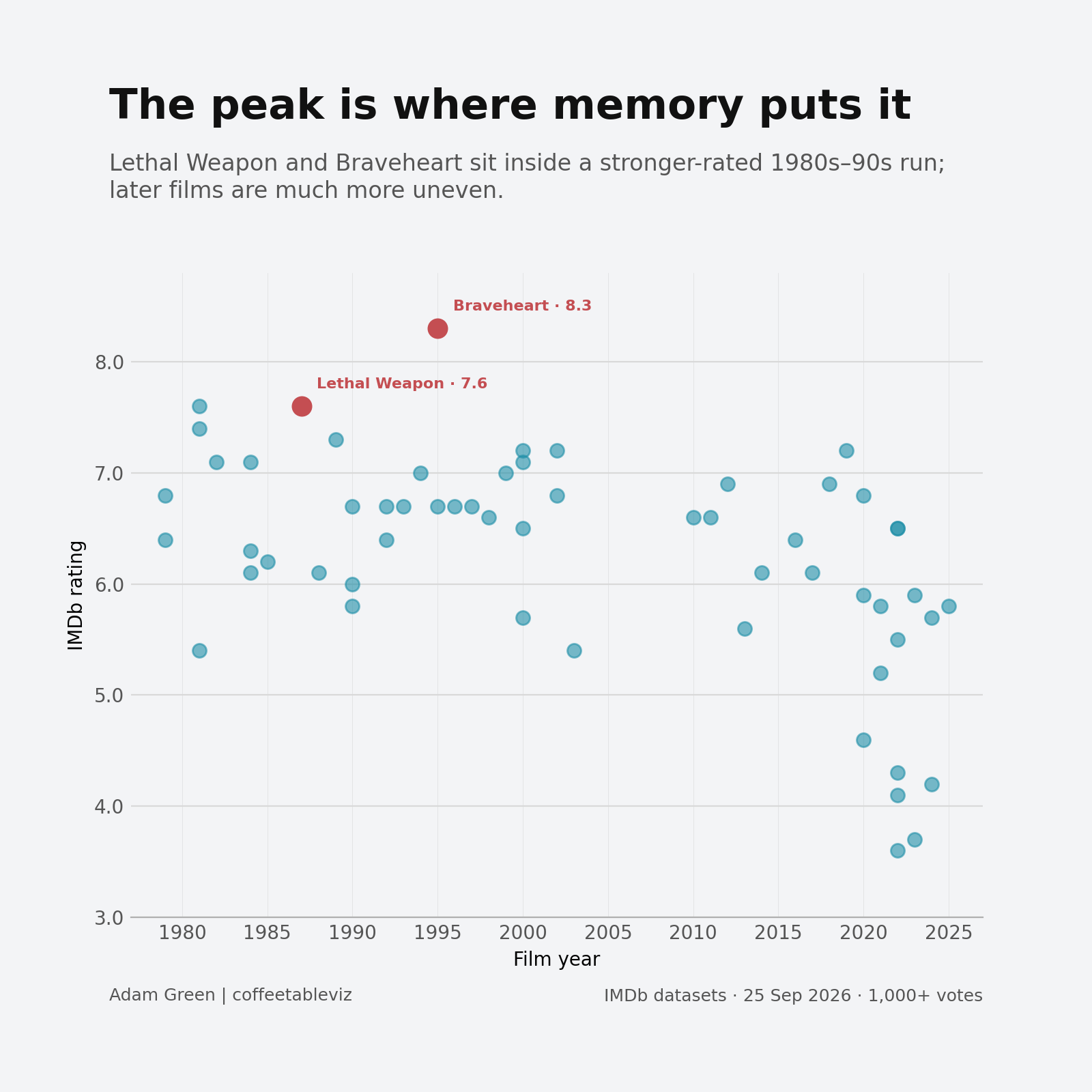
The 1980s and 1990s also have stronger typical ratings than the recent run. The median eligible acting-film rating is 7.1 in the 1980s and 6.7 in the 1990s, compared with 5.6 for 2020–25.
That sounds like a decline story. Then the second chart gets in the way.
He didn’t stop acting. He got busier.
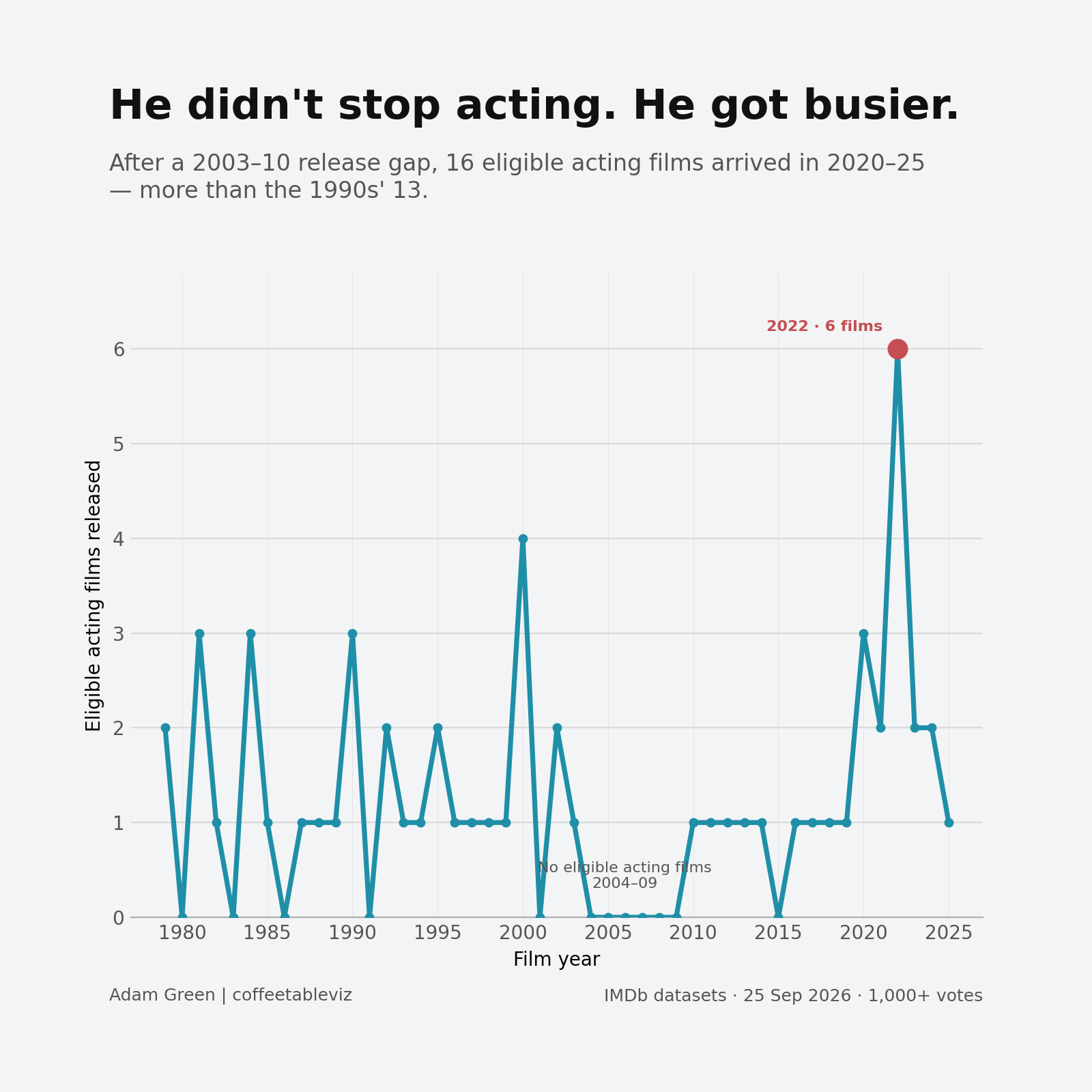
There is a real gap: no eligible acting films appear from 2004 to 2009, with the next one arriving in 2010.
But after that, the volume comes back.
From 2020 to 2025 there are 16 eligible acting films. The entire 1990s contains 13. In 2022 alone, six eligible films appear.
So “where did he go?” is slightly the wrong question.
He came back — just into a very different shape of career: more films, lower title ratings on average, and a less consistent sense of being at the centre of the big mainstream run I remember.
Directing became the second career
The other lane is much smaller.
Gibson has six released directing features in the analytical dataset, spread across more than three decades: The Man Without a Face, Braveheart, The Passion of the Christ, Apocalypto, Hacksaw Ridge and Flight Risk.
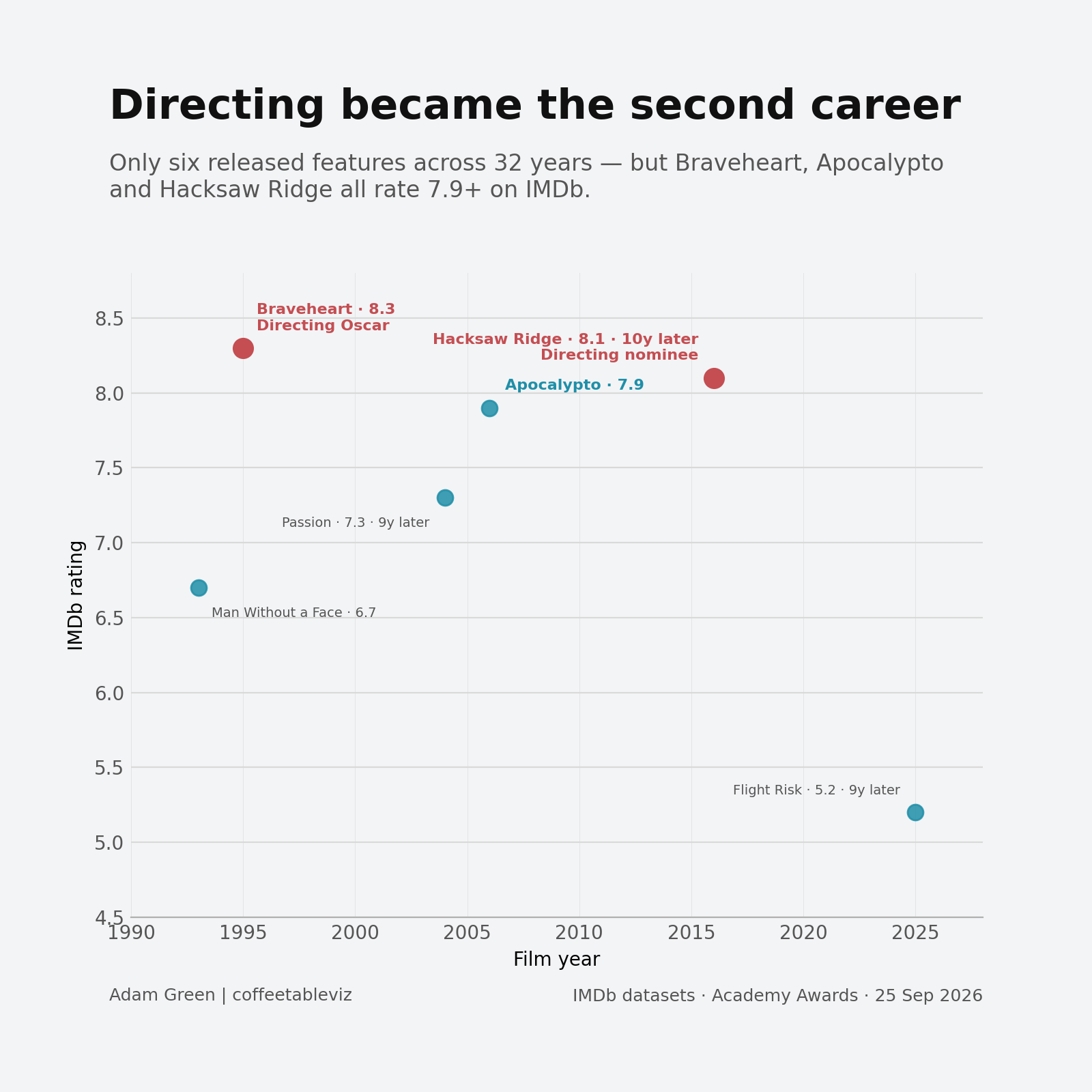
It is a sparse sequence, but it contains some striking points: Braveheart at 8.3, Apocalypto at 7.9, and Hacksaw Ridge at 8.1.
The gaps matter too. Later directing releases are separated by stretches of 9, 10 and 9 years. This was never a high-volume directing career; it was a second lane that appeared occasionally and sometimes landed very loudly.
TLDR
The data does not really support a simple “Mel Gibson vanished” story.
There is a genuine acting gap, but what follows is actually a busier acting period — 16 eligible films in 2020–25 versus 13 in the 1990s — alongside lower title ratings. Meanwhile, directing becomes a small, irregular second career with several of his strongest-rated films.
Riggs made the movie star. Braveheart changed the job.
simple charts clear stories.