Sport
Kimi Antonelli stands on the brink of F1 history
At 20, Kimi Antonelli could rewrite F1's youngest champion record. A comparison with season-long champions in tennis, golf and other individual sports puts the milestone into perspective.
Ahead of the United States Grand Prix on 25 October 2026. The world championship was not decided when this article was prepared.
Kimi Antonelli has a rather unusual opportunity today: he could become Formula 1’s youngest-ever world champion at 20.
He’s starting the United States Grand Prix from pole position, leading the championship by 102 points over Mercedes team-mate George Russell. But first place in today’s race would not be enough on its own: Formula 1’s title permutations say Antonelli needs to win, Russell must finish ninth or lower, and Lewis Hamilton must finish fifth or lower. The drivers behind him still have a say.
So, before the lights go out, here’s the rather interesting question.
How young is a young season champion?
1. F1’s youngest record is stubbornly difficult to beat
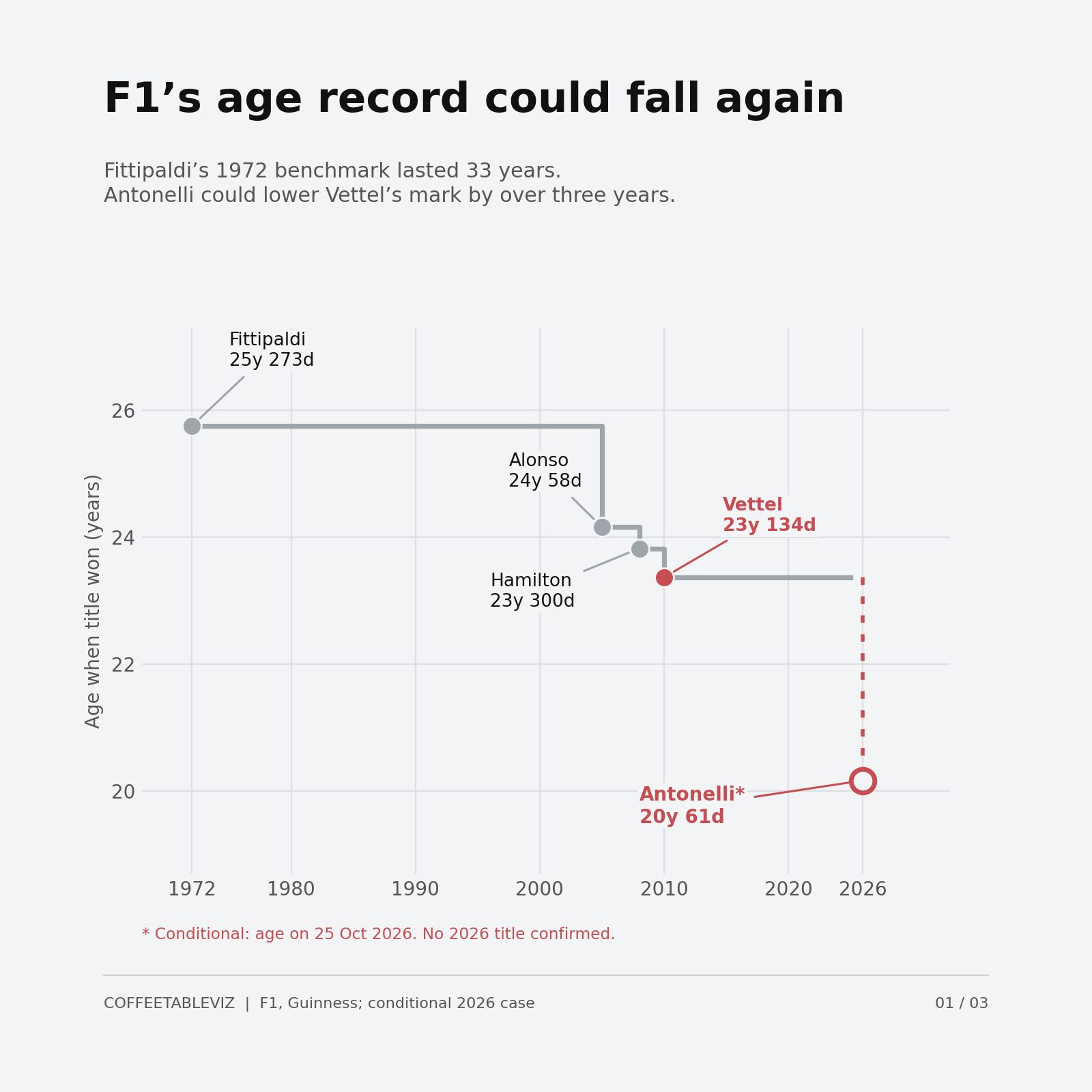
Sebastian Vettel became world champion in 2010 at 23 years and 134 days. That made him younger than Lewis Hamilton, Fernando Alonso and the long-standing record holder Emerson Fittipaldi had been when each broke the record.
If Antonelli clinches it today, he would be 20 years and 61 days old — more than three years younger than Vettel at his first title.
Not the sort of record you edge past by a fortnight.
The filled record-holder dots are confirmed; Antonelli’s hollow dot is a scenario for a title clinched in Austin on 25 October, not an achieved championship.
2. In other sports, 20 can sound almost old
Chloe Kim won the World Snowboard Tour’s overall season title at 13. Martina Hingis finished 1997 as WTA year-end No. 1 at 17. Lydia Ko topped the LPGA’s season-long Race to the CME Globe at 17, and Carlos Alcaraz finished 2022 as ATP year-end No. 1 at 19.
All remarkable. And all rather different routes to the top.
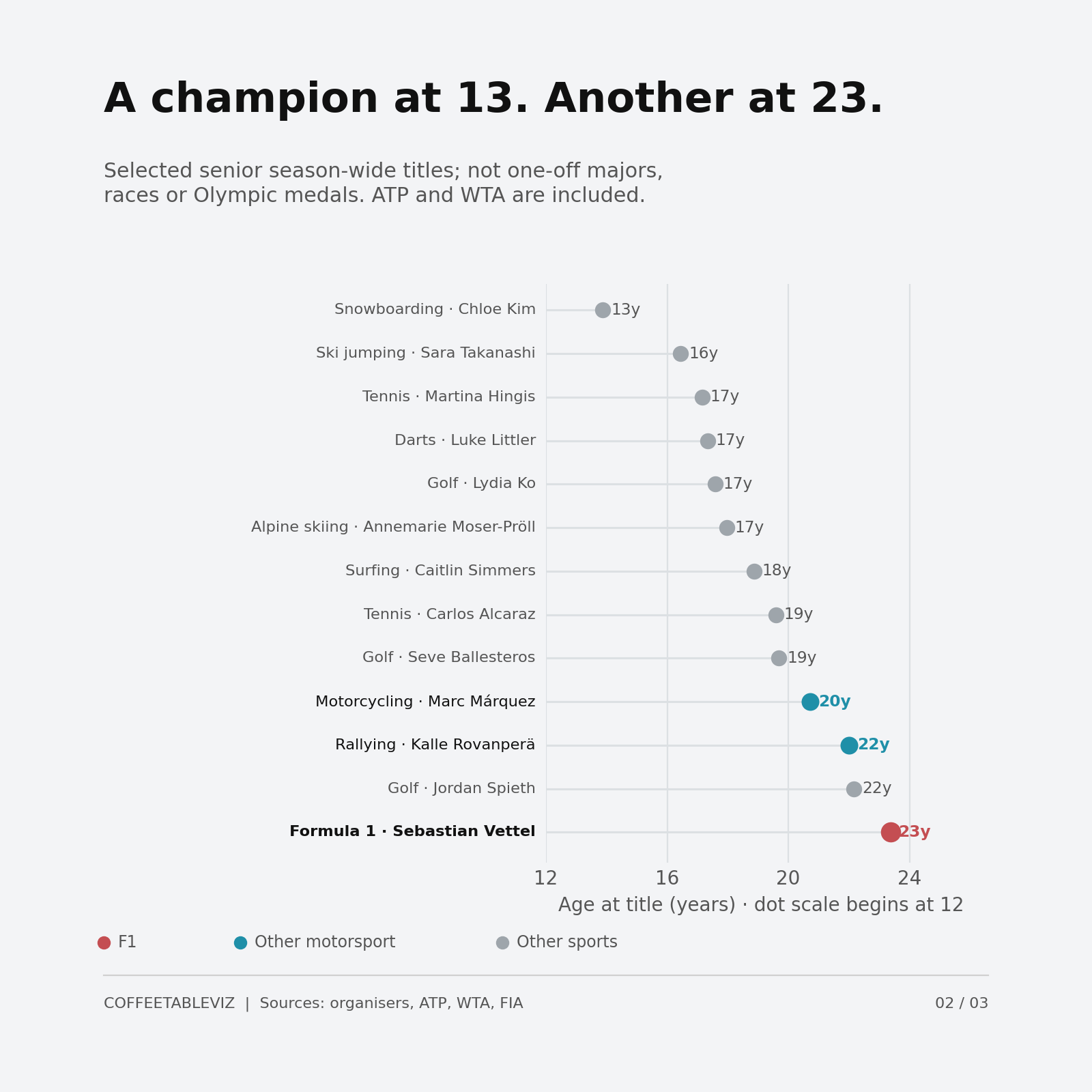
The red F1 dot is Vettel’s confirmed 2010 title record, not Antonelli’s possible 2026 achievement. The examples are a selected comparison, not a claim to have found the youngest person in every sport.
It’s tempting to turn this into a league table of who is most impressive. But that’s not what the data measures.
Age eligibility, career pathways, calendar length and the structure of a title race all influence when someone gets the chance to become champion.
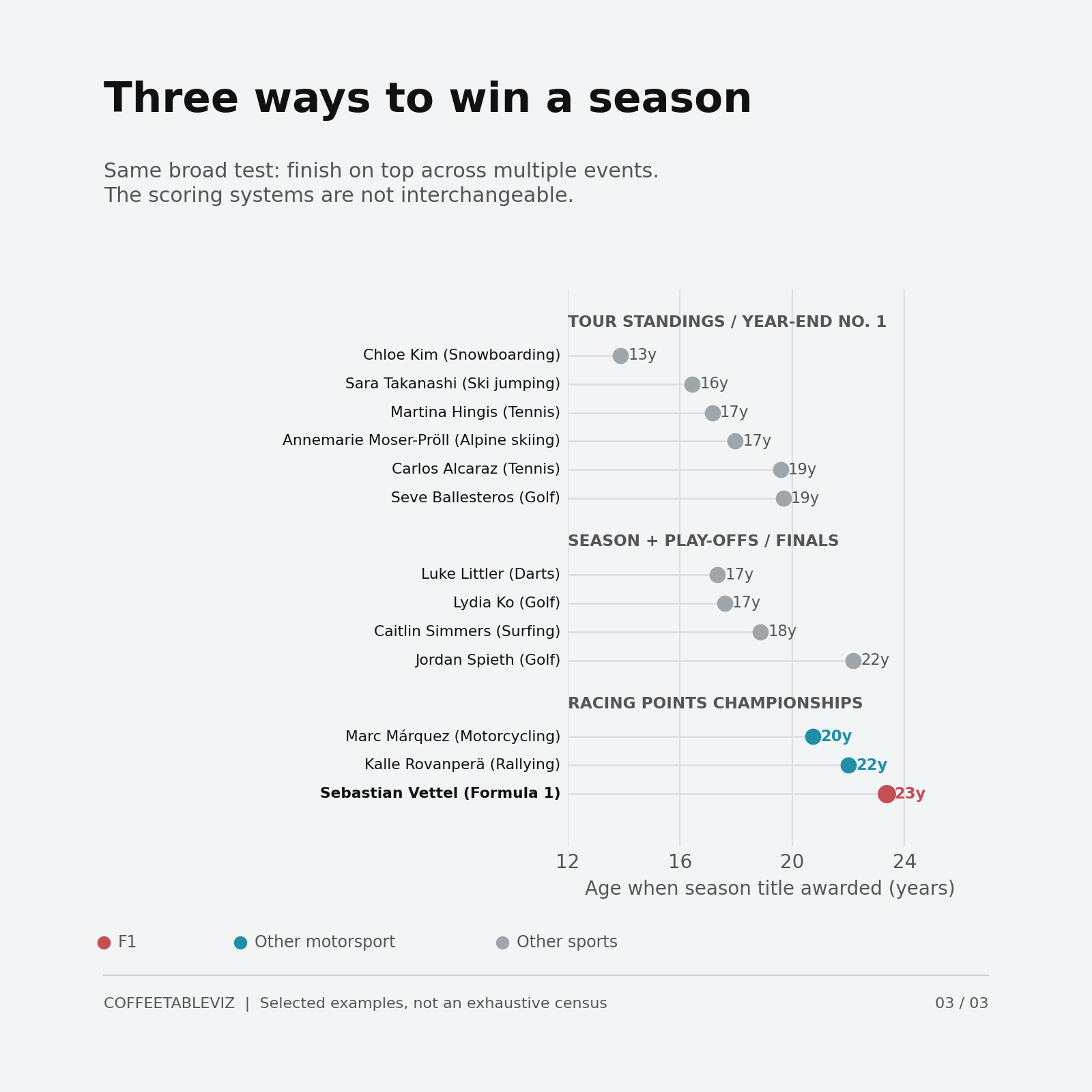
3. A season isn’t always scored the same way
To keep our comparison meaningful, there’s one deliberate boundary: the athlete must finish top of a senior competition played out across multiple events, rather than win one major, race or Olympic event.
Tennis fits: ATP and WTA recognise the player finishing the year at No. 1, based on tour ranking points. So does golf’s Order of Merit or the LPGA’s season-wide race. Motorsport uses race results accumulated across a championship. Other tours add a season finale.
The same question — who finished top? — but a few different ways of getting there.
The finish line is still ahead
Antonelli could leave Austin tonight with an extraordinary record. Or the title might have to wait for Mexico City or another race.
Either way, the wider comparison makes one thing clear: a world-class season can arrive at wildly different stages of a sporting career.
For Formula 1, 20 would be historic.
For a few other sports, we’ve already seen teenagers win the lot.
Perhaps there isn’t one perfect age to be a champion after all.
A note on the numbers
The three charts use 13 selected senior season-long titles and tour rankings, not an exhaustive all-sport census. Individual Grand Slams, golf majors, Olympic medals and single races are excluded. Comparisons show age, not how hard each title was to win.
Historic F1 ages are calculated at the championship-clinching race. Some other competitions use the official year-end ranking or season finale, meaning age-reference dates are not identical. The Antonelli point is conditional on a win in Austin and the necessary results elsewhere.
Main references: Formula 1 — title permutations, Guinness — youngest F1 world champion, WTA — Martina Hingis, ATP — Carlos Alcaraz year-end No. 1, LPGA — Lydia Ko. Further individual title sources and age-reference dates are documented in the research project on GitHub.
More sporting numbers and curious comparisons at coffeetableviz.com.