Sport
The record fell. The legacy didn't.
Eleven wins, two world records, and a 78-second leap. What the #ShortsInSports marathon data says about Eliud Kipchoge.

In April 2026, the marathon finally went under two hours in an official race.
1:59:30. Sabastian Sawe. London.
Not Eliud Kipchoge.
An odd opening to a Kipchoge story, perhaps. But records are there to be broken. Dominance is another matter.
A little dive into the #ShortsInSports marathon dataset, kindly shared by Rob and Chris, offers three rather good reasons to remember him.
Eleven. Five. Quite a gap.
Across the six races in this dataset, Kipchoge won 11 times. The next-best runners managed five.
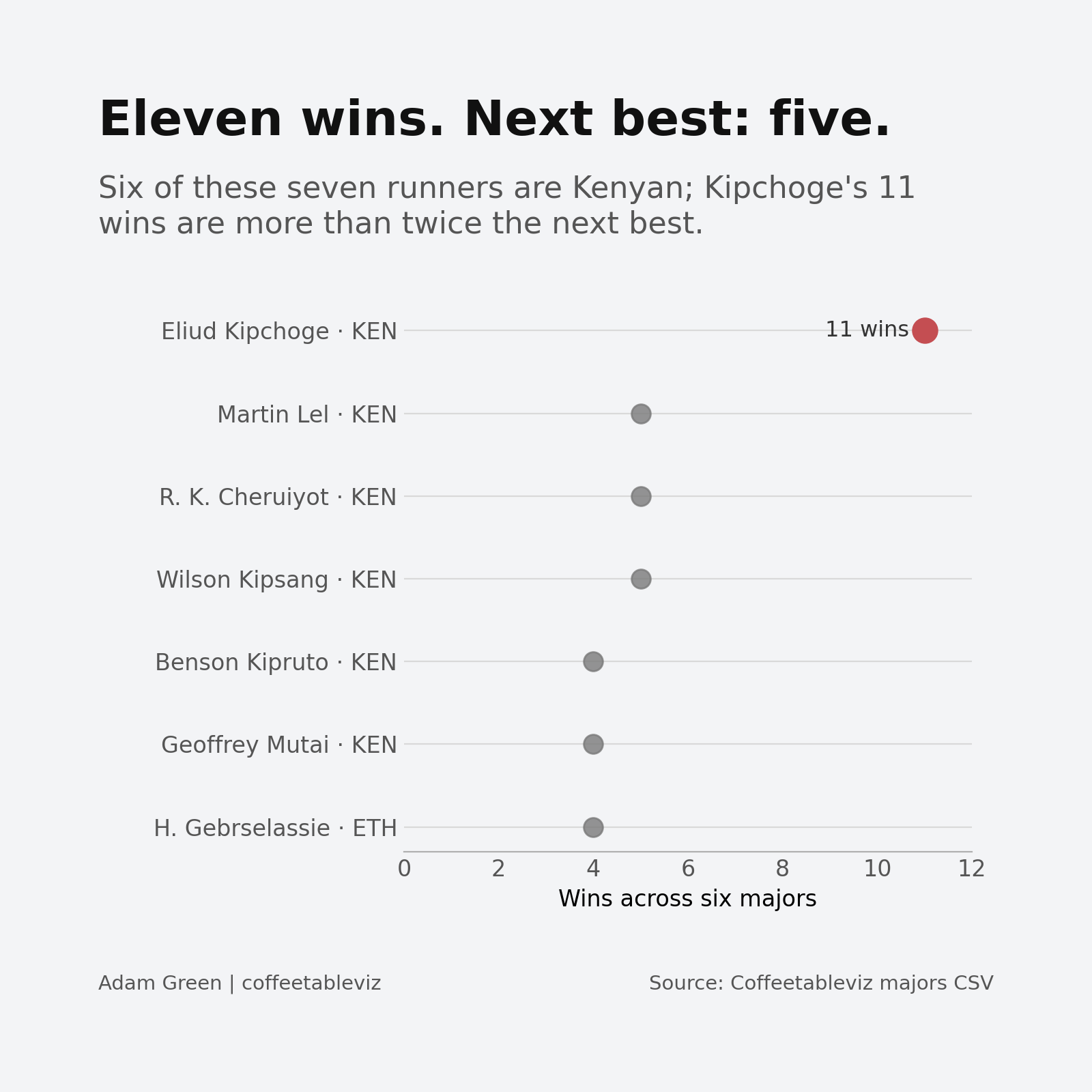
Six of the seven leading names are Kenyan, with Ethiopia’s Haile Gebrselassie the exception. But even in that company, Kipchoge is a long way out in front.
And his two Olympic marathon golds aren’t included. Another couple of medals for the shelf.
Fast at 29. Still winning at 38.
His first win here was Chicago 2014, aged 29. His last was Berlin 2023, aged 38.
And between those two? A pair of world records.
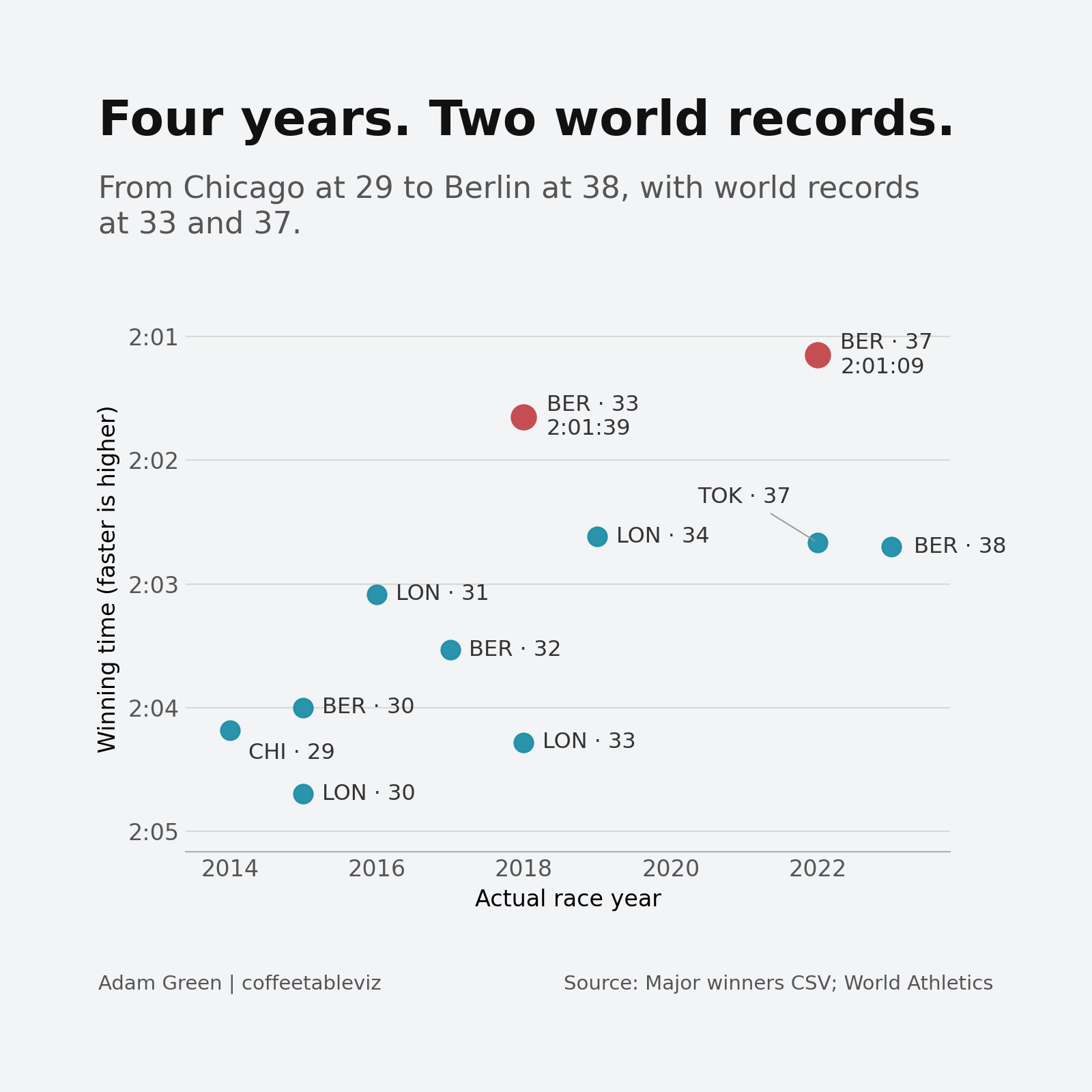
The red dots mark Berlin 2018 (2:01:39) and Berlin 2022 (2:01:09). Four years apart, at ages 33 and 37.
The other times bounce around. Different courses, weather, tactics. Winning isn’t necessarily about running a personal best every Sunday.
But setting your fastest official marathon time eight years after your first win here? That’s some staying power.
Seventy-eight seconds. In one go.
In 2018, Kipchoge took the men’s world record from 2:02:57 to 2:01:39.
A whopping 78 seconds.
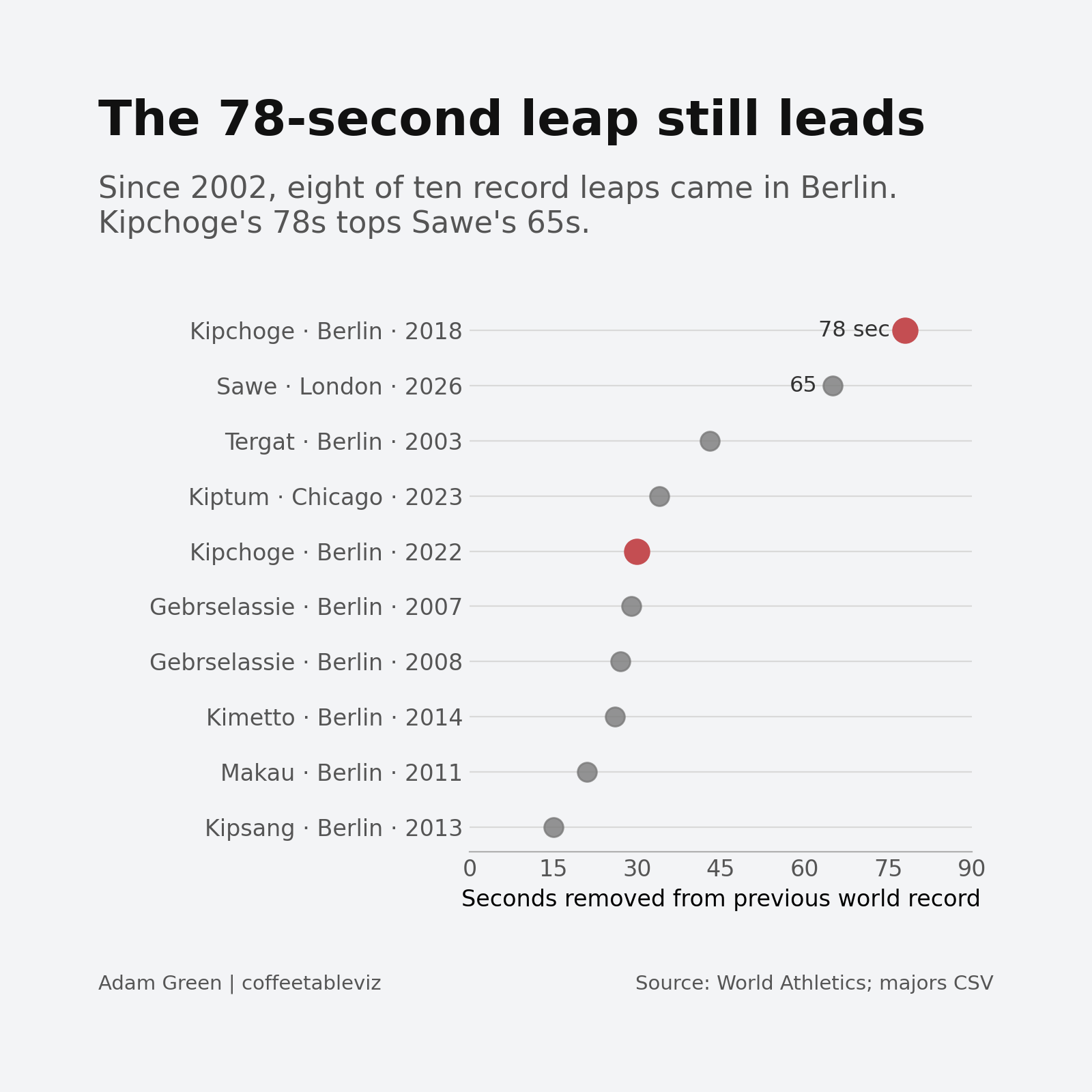
Since the 2002 baseline used here, no single improvement has beaten it — not even Sawe’s extraordinary 65-second leap in 2026.
There’s another little Berlin story hiding in the labels: eight of these ten record improvements happened there.
Of course, Kipchoge had already gone under two hours in Vienna in 2019. His 1:59:40 was an organised challenge, not an official world record. Still quite an afternoon.
TLDR
Sawe owns the official record. But Kipchoge’s 11 major wins in this dataset and 78-second record leap remain remarkable.
The clock moved on. The legacy didn’t.
simple charts clear stories.
A note on the numbers
The starting point is the #ShortsInSports marathon majors dataset. Thanks to Rob and Chris for providing the data. The charts use the Coffeetableviz working CSV, containing 149 completed men’s races across six city marathons from 2000–26. Berlin 2026 is absent, and Sydney isn’t included. This is not a complete all-time Majors ranking.
Known name variants were reconciled; many source results haven’t been independently checked. Chart 2 shows winning performances only, with race-day ages; Tokyo’s 2021 edition was run in March 2022. Chart 3 compares the ten official world-record improvements after the 2002 benchmark, not all marathon performances.
Record figures were checked with World Athletics (2018), World Athletics (2022) and World Athletics (2026).