Music
How do you measure a chameleon?
David Bowie released 26 lifetime solo studio albums across six named decades. A simple style-reset score shows repeated change — and the limits of trying to measure reinvention.

David Bowie is one of those artists routinely described as endlessly reinventing himself.
The phrase feels right. It is also suspiciously difficult to measure.
So I tried.
This story starts with Bowie’s lifetime solo studio catalogue: 26 albums, from the 1967 debut to Blackstar in 2016. That is a 49-year difference between the first and last album years, spread across six named calendar decades.
The interesting question is not whether Bowie was creative, influential or important. A chart is not going to settle that.
The question is narrower: can the catalogue data show repeated changes in musical direction — and what happens when we try to reduce those changes to one number?
Six decades. Twenty-six albums.
Start with the uncomplicated bit.
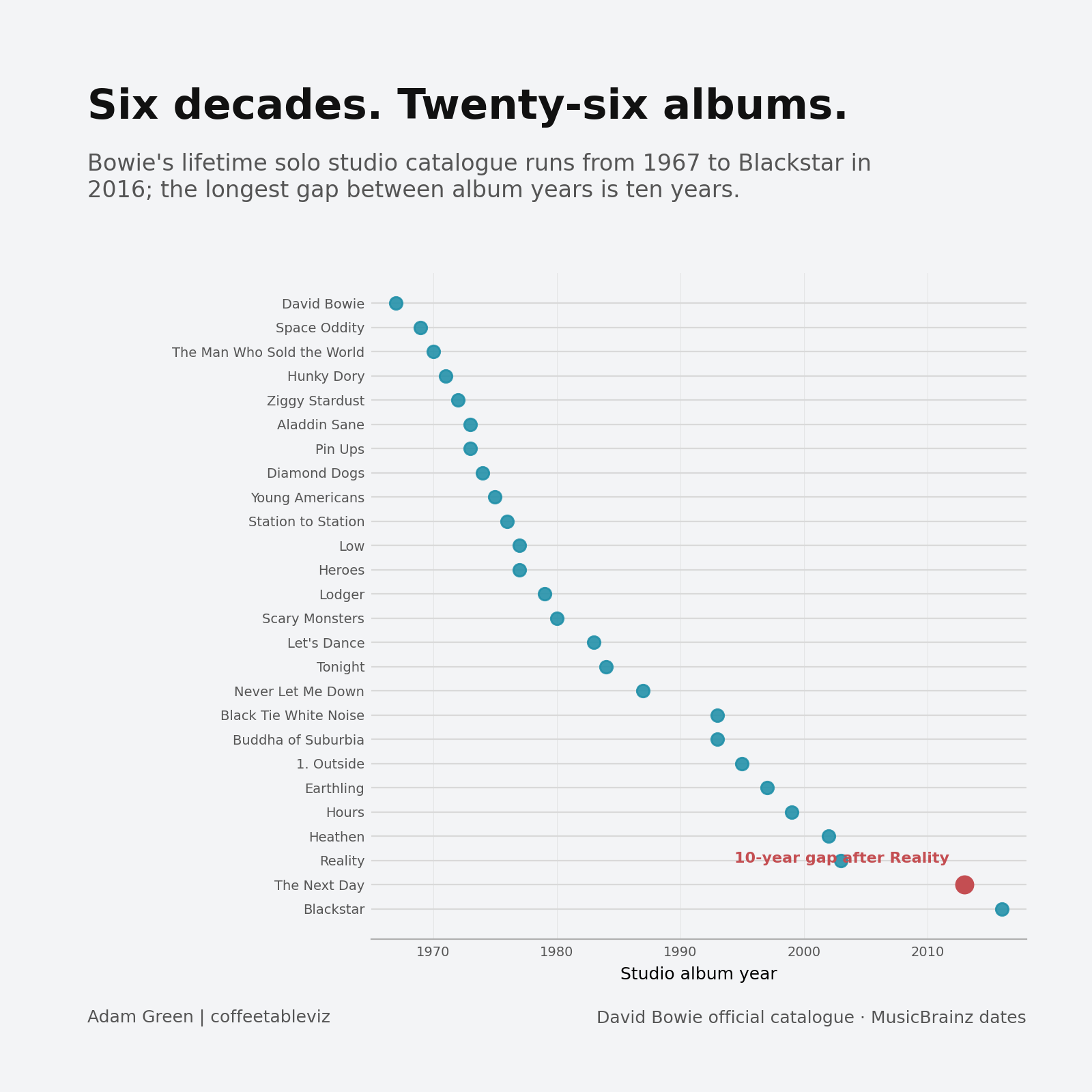
Twenty-six records is a lot of opportunities to change course.
The chronology also has its own rhythm. The 1970s are packed. The 1980s and 1990s keep moving. Then there is the ten-year pause between Reality in 2003 and The Next Day in 2013 before Blackstar closes the sequence in 2016.
Longevity, though, is not the same thing as reinvention.
For that, we need to look inside the labels attached to the albums.
The labels rarely sit still
Rather than force every album into one genre, I used the album-level Styles listed by AllMusic and tracked how the distinctive labels appear across the chronology.
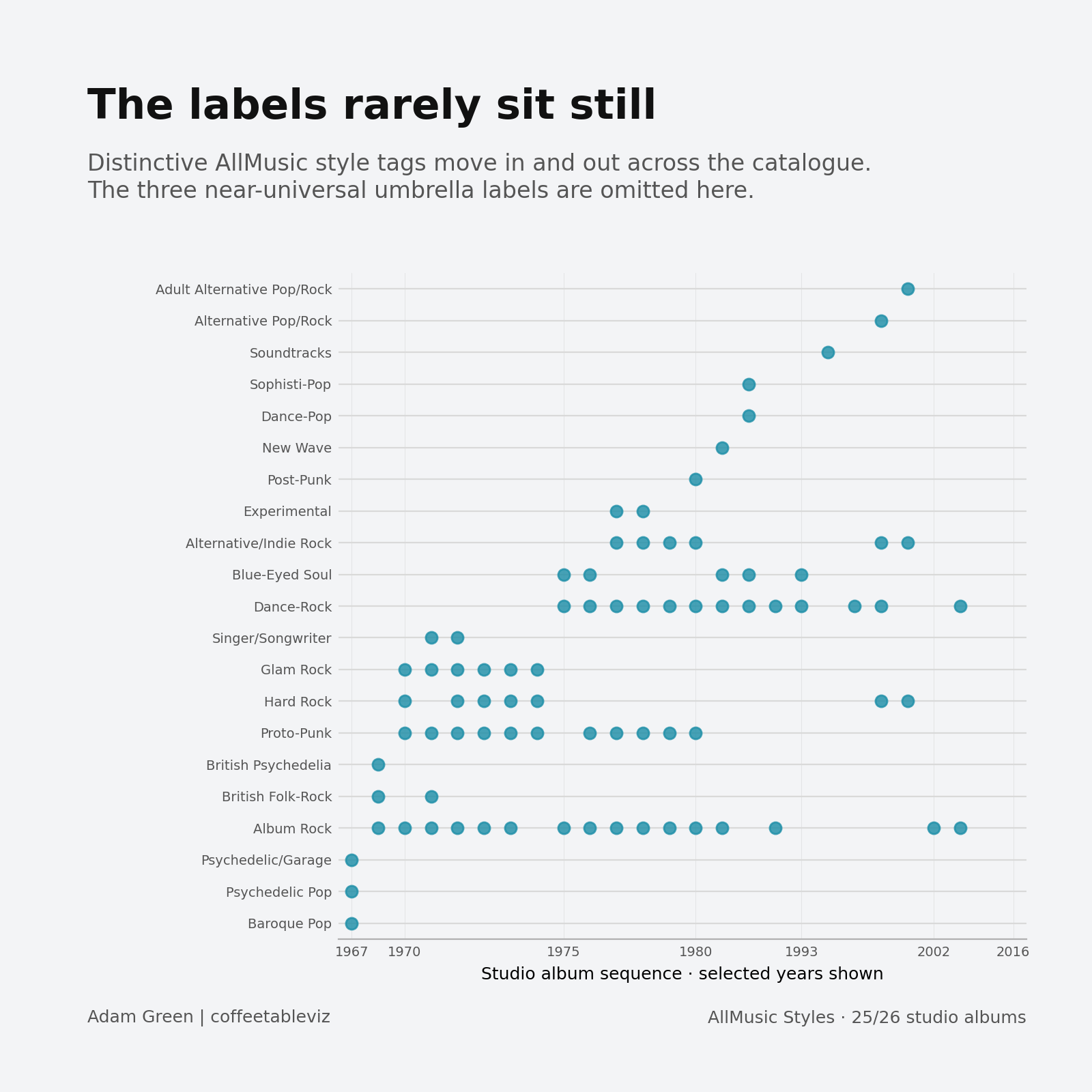
Across the 25 albums with comparable AllMusic Styles metadata, there are 24 distinct style labels.
Some are so broad that they appear almost everywhere: Contemporary Pop/Rock on 24 of those 25 albums, Art Rock on 23, and Experimental Rock on 22. I left those three near-universal labels out of the display so they do not swamp the more distinctive movement underneath.
What remains is much more interesting.
Glam Rock clusters early. Blue-Eyed Soul and Dance-Rock arrive later. Post-Punk appears around Scary Monsters. Alternative/Indie Rock becomes part of the later vocabulary.
The labels are imperfect, but they plainly do not sit still.
Which raises the dangerous question.
Could we score the movement?
A reinvention score gets awkward
I used a deliberately simple measure.
For every adjacent pair of albums, I compared their complete AllMusic Styles sets using Jaccard similarity — shared labels divided by all labels present across the pair — then flipped it:
style reset score = 1 − similarity
Higher means less overlap.
Twenty-six albums create 25 possible album-to-album moves. The debut itself does not get a score because there is no previous album to compare it with.
AllMusic currently exposes comparable Styles data for 25 of the 26 albums. The Next Day is the exception, so the two moves touching it cannot be scored consistently. They stay in the chart as grey missing-data rows rather than being quietly turned into zero.
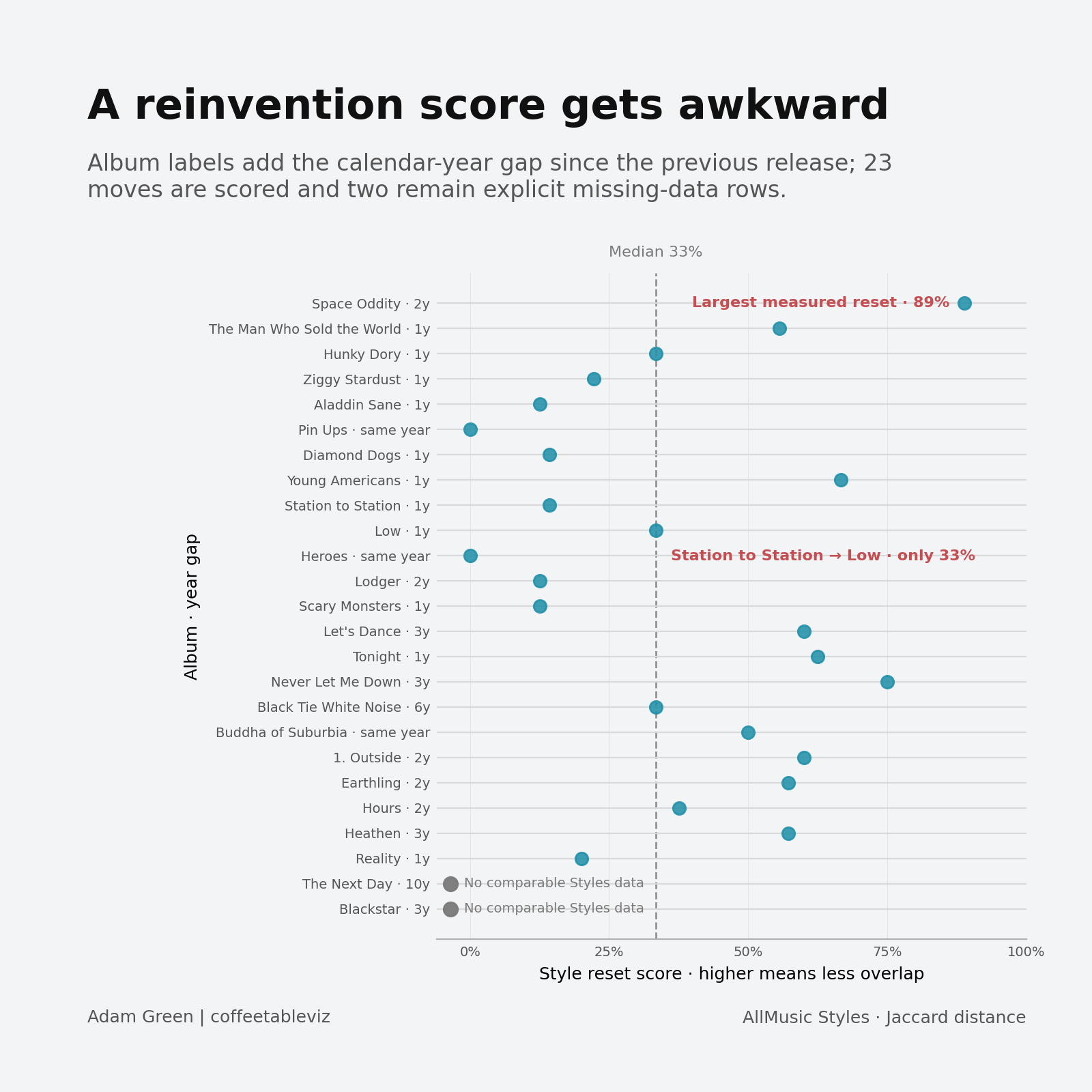
The largest measured reset is the 1967 debut → Space Oddity at 89%.
Tonight → Never Let Me Down reaches 75%.
Diamond Dogs → Young Americans lands at 67%.
Scary Monsters → Let’s Dance reaches 60%.
Then the score gets awkward.
Station to Station → Low lands at only 33% — exactly around the median measured reset.
Why? Because six broad AllMusic labels remain shared between the two records.
That is not a failure of the chart. It is the point of it.
The metric is measuring taxonomy turnover, not creativity, intent or artistic significance. Broad labels can survive while the music underneath them changes considerably.
So the data gives us two useful things at once.
It shows a catalogue that repeatedly changes its descriptive vocabulary.
And it shows the limit of pretending those labels are the same thing as the art.
More time doesn’t guarantee a bigger reset
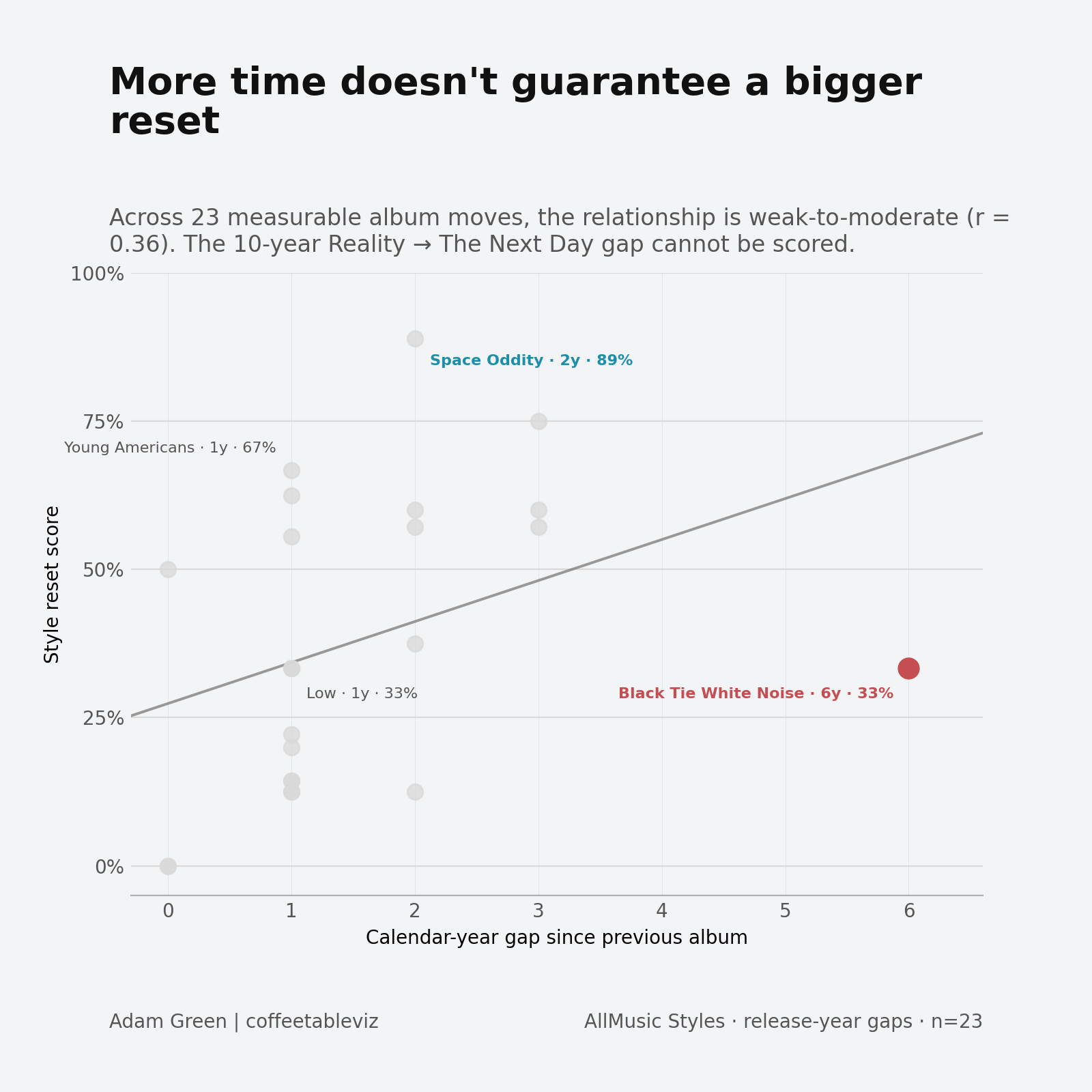
One obvious follow-up question is whether bigger gaps between albums tend to mean bigger stylistic resets.
Sometimes they do. But not reliably.
Across the 23 measurable transitions, the relationship between calendar-year gap and style reset is only modest: Pearson r = 0.36.
That is enough to suggest some association, but nowhere near enough to say that time away automatically leads to reinvention.
The exceptions are the useful part.
The biggest measured reset in the catalogue is the 1967 debut → Space Oddity, which follows only a 2-year gap. By contrast, Black Tie White Noise arrives after a 6-year gap and scores only 33%.
There is also one important hole in the picture. Bowie’s longest studio-album hiatus — 10 calendar years, from Reality (2003) to The Next Day (2013) — cannot be plotted here because The Next Day has no comparable AllMusic Styles metadata.
So time away helps as context, but it does not explain reinvention on its own.
TLDR
David Bowie released 26 lifetime solo studio albums from 1967 to 2016, spanning six named calendar decades.
Distinctive style labels repeatedly enter, disappear and return across the catalogue. A simple adjacent-album reset score captures some of that movement, with the debut → Space Oddity transition scoring 89%.
But Station to Station → Low scores only 33% because broad labels remain shared.
Longer gaps help a bit, but only a bit: across the 23 measurable transitions, the gap/reset relationship is modest (r = 0.36) rather than decisive.
The score is useful.
It just cannot become the art.
simple charts clear stories.